
When You Still Feel in Control, But You’re Not
Every helicopter pilot has heard it at some point: “I’ll just continue a little farther.” As visual references disappeared, pilots began making significantly more control inputs. Cyclic movements increased, aircraft attitude fluctuated more frequently, and workload rose sharply.
Weather rarely collapses instantly. More often it deteriorates gradually, visibility lowers, contrast fades, the horizon softens, and before the brain fully registers the change, the aircraft is already operating in a completely different environment.
For decades, aviation safety discussions surrounding inadvertent flight into instrument meteorological conditions have focused primarily on fixed-wing aircraft. While helicopters routinely operate in marginal visual environments, comparatively little experimental research has quantified helicopter pilot control performance during transitions from visual to instrument conditions. A controlled study conducted by Crognale and Krebs (2011) remains one of the few investigations to objectively measure pilot control inputs and workload during gradual VMC-to-IMC transitions. Even today, quantitative research of this type remains relatively scarce within helicopter operations when compared with the extensive fixed-wing literature.
The study revealed something both reassuring and deeply unsettling. Pilots often did not immediately lose control. Instead, something more subtle, and potentially more dangerous, occurred.
The Illusion of Control
In the study, experienced commercial helicopter pilots, many with thousands of flight hours and instrument ratings, were gradually transitioned from visual conditions into simulated IMC. Most pilots kept the aircraft upright, and there was no dramatic or immediate catastrophe. From the outside, the flight often appeared stable.
Yet detailed analysis told a different story. As visual references disappeared, pilots began making significantly more control inputs. Cyclic movements increased, aircraft attitude fluctuated more frequently, and workload rose sharply. Although the helicopter remained flyable, the pilot was working much harder simply to maintain basic control. The aircraft could appear stable while the pilot was already approaching cognitive saturation, and that moment is rarely perceived clearly from inside the cockpit.
Experience Is Not Immunity
One of the more surprising findings was that total flight time did not strongly predict performance during the transition into IMC. Highly experienced pilots were not automatically protected. Inadvertent IMC is not primarily a knowledge problem; it is a limitation of human sensory systems.
Helicopter flying depends heavily on visual cues, peripheral motion, terrain contrast, horizon perception, depth awareness. Remove those cues and the brain must abruptly transition from visual flying to instrument interpretation. That transition is where accidents often begin, not because pilots lack skill, but because the vestibular system continues to provide convincing, and frequently false, sensations while confidence can remain deceptively high.
Visibility Matters More Than We Think
Interestingly, altitude and airspeed were not the dominant factors affecting performance. The strongest degradation occurred simply from the loss of visibility itself. This challenges the assumption that danger arises mainly from low altitude or confined terrain. The study suggests that the hazard begins the moment visual reference is lost, regardless of altitude. The helicopter has not changed; the environment has, and more importantly, the pilot’s perception has changed.
Training Works, Quickly
There is, however, encouraging news. Pilots in the study demonstrated significant improvement after only a small number of repeated IMC exposure sessions. Short, focused training reduced control fluctuations and workload in measurable ways, particularly after the initial exposure. Recurrent practice appears to accelerate the transition from visual dependence to effective instrument control, strengthening recognition and response pathways that theory alone cannot provide. Training does not eliminate risk, but it delays cognitive overload, and in operational terms, that delay can mean the difference between recognizing deteriorating conditions early enough to transition effectively, versus reacting after performance margins have already eroded.
A Professional Reflection
Accidents rarely begin when pilots feel overwhelmed. More often they begin earlier, when the pilot still feels capable, when continuation still seems reasonable, and when turning around appears unnecessary. Loss of control is frequently preceded not by loss of skill, but by loss of margin. Helicopter operations routinely place pilots closer to terrain, weather, and operational pressure than most other forms of aviation. EMS missions, offshore transport, law enforcement patrols, and utility operations all share one reality: weather decisions are rarely black and white.
Science now reinforces what experience quietly teaches over time. The most dangerous phase of inadvertent IMC is not the crash itself, but the moment when everything still appears manageable. Recognizing that moment, and acting before workload silently overwhelms perception, may be one of the most important professional skills a helicopter pilot can develop. Sometimes the safest decision is made before the situation feels unsafe, and that decision often determines whether the flight becomes a lesson… or a statistic.
By Jeiser Medina

Mar 02, 2026
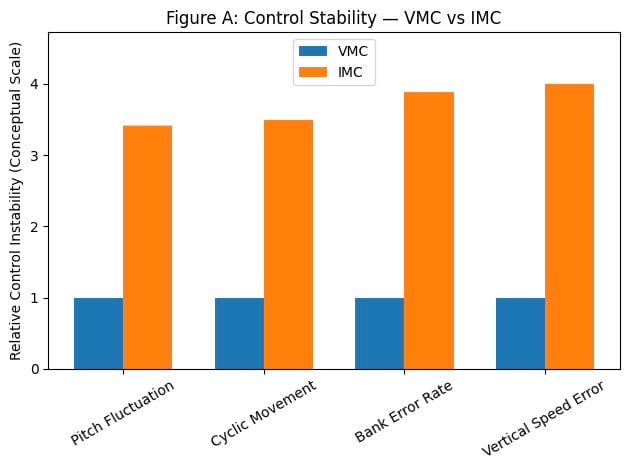
Figure A. Conceptual comparison of helicopter control stability under visual (VMC) and instrument (IMC) conditions. Across multiple performance measures, including pitch fluctuation, cyclic movement, bank error rate, and vertical speed error, control variability increased significantly under IMC. This visualization reflects the overall trends reported by Crognale & Krebs (2011), illustrating that visibility loss leads to elevated control workload and greater aircraft attitude instability rather than immediate loss of control.
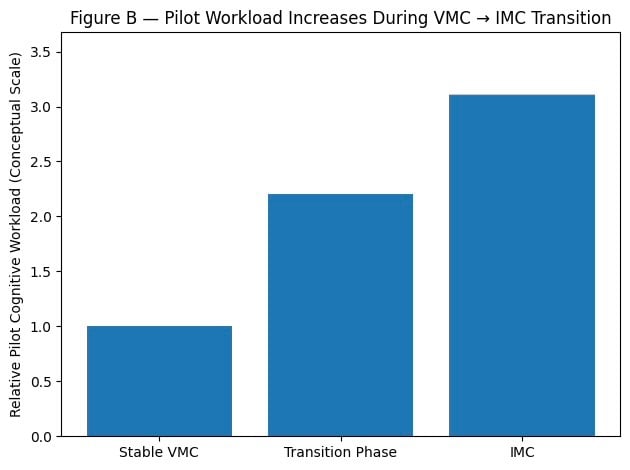
Figure B. Conceptual illustration of increasing pilot cognitive workload as visual conditions deteriorate from stable VMC through the transition phase into IMC. Findings reported by Crognale & Krebs (2011) showed that pilot control activity and workload increased significantly before obvious performance errors appeared, highlighting the critical phase in which pilots may still perceive the aircraft as under control while cognitive demand rapidly escalates.
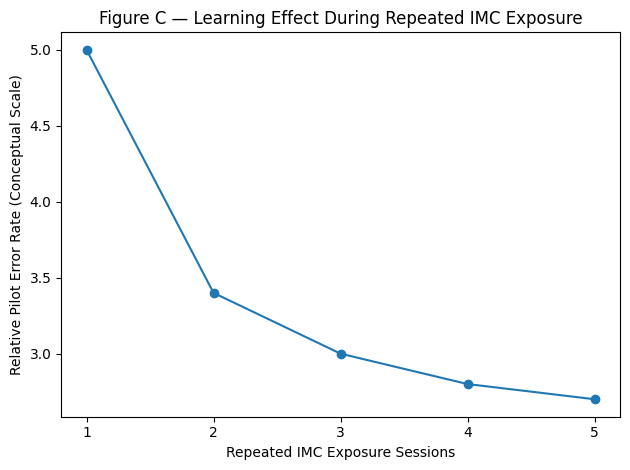
Figure C. Conceptual representation of the learning (order) effect observed during repeated exposure to inadvertent IMC conditions. In the study by Crognale & Krebs (2011), error rate did not represent a simple count of mistakes, but rather the proportion of time during which aircraft attitude or control inputs exceeded predefined stability limits. The largest reduction in control error rate occurred after the first exposure session, with subsequent sessions showing continued but smaller improvements. These findings suggest that short, focused recurrent training can significantly reduce control instability during unexpected IMC transitions, although performance variability remains present.
This article provides independent professional interpretation and educational discussion of the research findings.
Reference:
Crognale, M. A., & Krebs, W. K. (2011).
Performance of Helicopter Pilots During Inadvertent Flight Into Instrument Meteorological Conditions.
International Journal of Applied Aviation Studies.
Available at: